
Beyond Age 2026 – Changing AI and tech habits
What does age really tell us about Britain’s changing AI and tech behaviours? Our TGI data reveals where – and how much – age matters in understanding and targeting consumers.
This is the second infographic in our four-part Beyond Age series, exploring the role age plays in media and marketing today. Here are three trends marketers need to know:
- Age won’t tell you who’s excited about AI
- AI use is where age starts to matter
- The ‘young tech user’ stereotype is fading fast
1. Age won’t tell you who’s excited about AI
The youngest adults are no more excited about AI’s future than older generations.
In fact, well over half of 16-24 year olds worry about AI’s impact on jobs and its potential to spread misinformation.
Often, enthusiasm around innovation and tech developments is led by the young. But for marketers, youth should not be a proxy for AI optimism.
Agree: “I am curious to see how AI will evolve and influence our society” – proportion in each age group.
GB TGI 2026 June (May 2025 – April 2026) – © Fifty5Blue 2026
Want to find the AI optimists? Follow the tech spend
Tech buyers are far more likely to feel positive about AI than adults overall.
Purchase intent of tech is a stronger signal than age and a better fit for campaigns where AI enthusiasm matters.
Agree “I am curious to see how AI will evolve and influence our society” – % more likely to intend to purchase this in next 12 months vs average adult
GB TGI 2026 June (May 2025 – April 2026) – © Fifty5Blue 2026
2. AI use is where age starts to matter
More than a quarter of 25-34 year olds use AI at least once a day, compared to fewer than 5% of those aged 65+. The lesson? How people feel about AI and how they use it are two different things. Marketers need to understand where AI truly fits into people’s lives.
% in each age group who use AI once a day or more
GB TGI 2026 June (May 2025 – April 2026) – © Fifty5Blue 2026
For younger consumers AI is becoming the new search bar
Almost half of 16-24 year olds start their product search with a chatbot. They are also a lot more likely to use AI for getting ideas or inspiration (e.g. travel, cooking) and for creating social media content.
This has big implications for marketers in where to put campaign investment when targeting younger vs older adults. If your search strategy ignores AI, you may already be missing younger audiences.
% in each age group who agree “I use an AI chatbot as my starting point when I am looking for product recommendations”
GB TGI 2026 June (May 2025 – April 2026) – © Fifty5Blue 2026
3. The ‘young tech user’ stereotype is fading fast
Tech ownership itself can change quickly across age groups. Take the Apple Watch. Nearly five million adults in Britain claim to own one.
But its ownership age gap has narrowed dramatically in recent years. Older adults are now nearly as likely as younger ones to own an Apple Watch.
Apple watch owners: % of owners in older age groups vs younger
GB TGI 2026 June (May 2025 – April 2026) – © Fifty5Blue 2026
Affordability may be one reason why the gap is narrowing.
But the bigger lesson is this: age profiles move.
Marketers need to follow fluctuations in behaviour closely and avoid assumptions that can quickly end up outdated.
Why Beyond Age?
Our Beyond Age series explores what age explains about consumer behaviours today. This is more important today than ever, as:
Age is still often the go-to differentiator when buying audiences
But it won’t always be the best fit. The breadth of our TGI data means you can always find the right metrics when targeting.
Age can be a ‘false friend’
Consumer behaviours change, but assumptions often don’t. TGI lets you test what you think you know against what consumers are actually doing now.
Behaviours move. Your targeting should move with them.
As media and technology habits change fast, up-to-date data becomes critical. TGI shows you where age still explains behaviour – and where other signals become more powerful.
Our Beyond Age content explores the role of age across a range of sectors, with an infographic of key insights released for each theme.
Explore the previous chapter: Age and changing media habits.
Let us guide your next steps in media understanding and targeting
A true understanding of consumers starts with real people. TGI cuts through the noise to bring you clarity into the who, why and how of people as they live their lives.
Below are just some of the ways we can further support your business. Ready to understand your audience beyond age? Talk to our team:
[email protected]
+44 (0)20 4557 6500
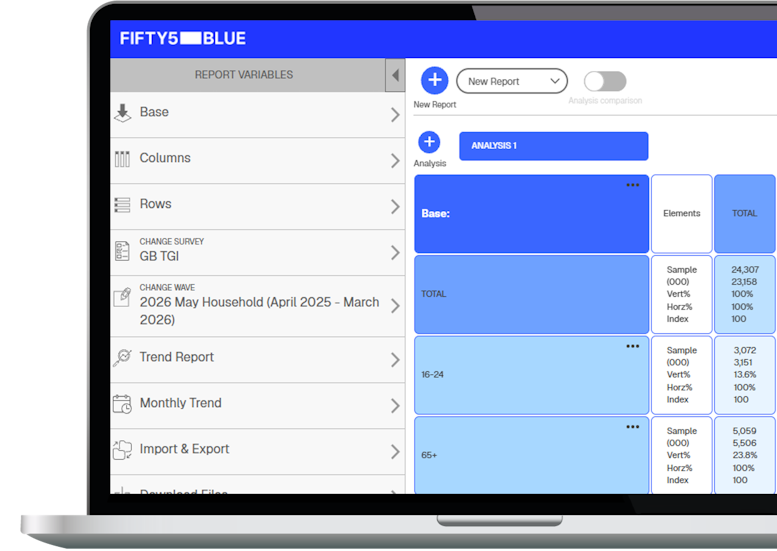
Target richly-built targets online
Targeting online with richly built audiences rather than more generic targets can be a far more efficient means of reaching a target audience. At TGI we have hundreds of pre-built audiences ready for immediate online activation, or you can build your own bespoke audience.
Directly connect your data to TGI for enriched insights
Combining the depth of your own consumer data with the unique breadth of behaviours, attitudes and characteristics means you can engage audiences with greater impact. We provide a range of options for integration TGI into your existing data, including API, flat file and – for AI linkage – MCP.
Target at pinpoint geographic resolution
Discover exactly where specific consumer audeinces are located, right down to district and sector postcode level for better targeted campaigns, with TGI’s dedicated geo-targeting capabilities.